
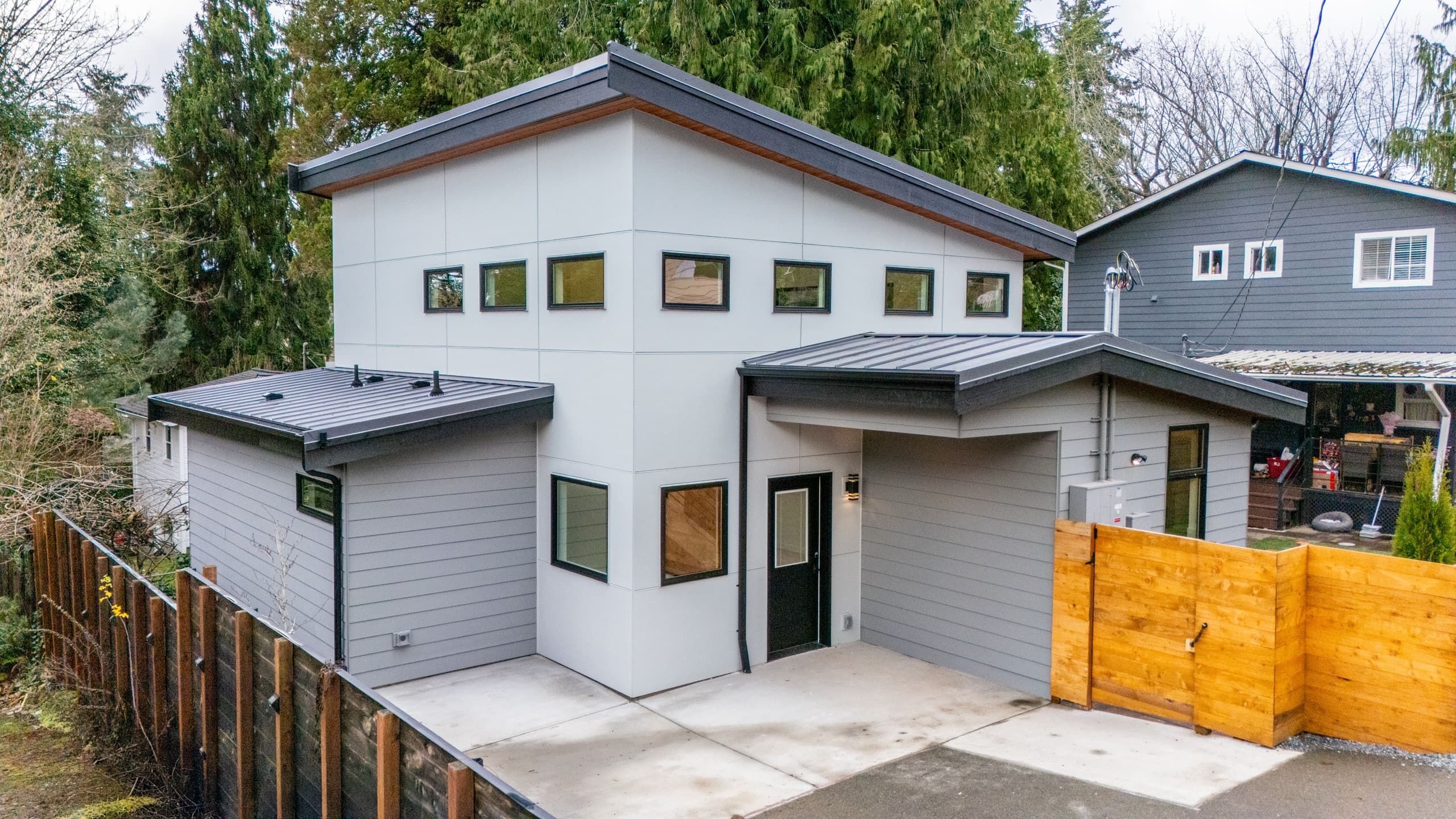
Seattle backyard homes, answered.
Clear, honest answers to the questions homeowners actually ask about building an ADU or DADU in the Greater Seattle area — cost, permits, zoning, timeline, renting and more.
- Company
- DIGS Construction and ADU Builder
- Owner
- Eric Dexter, Owner & Builder
- Building since
- 1989
- Experience
- 37+ years, 100+ DADUs & homes
- Specialty
- ADUs, DADUs & custom homes
- Service area
- Greater Seattle · King & Snohomish County, WA
- WA license
- DIGSES*775LE
- Typical DADU cost
- $375,000 – $600,000+ all-in
- Rating
- 5.0★ (7 reviews)
What these backyard homes are and how they differ.
What is a DADU?
A DADU is a Detached Accessory Dwelling Unit — a fully independent, standalone home built on the same lot as a main house, most often in the backyard. It has its own kitchen, bathroom and entrance, and in Seattle it is commonly called a backyard cottage.
What does ADU mean in housing?
In a housing context, ADU (Accessory Dwelling Unit) is a form of "missing middle" housing — a smaller, independent home added to an existing single-family lot to gently increase housing supply without changing neighborhood character. Washington has embraced ADUs and DADUs as a key way to ease the housing shortage.
What are the downsides of an ADU?
The main drawbacks are a high cost per square foot (a small unit still needs a full kitchen, bath and utility connections), the loss of usable yard, a 12 to 18 month timeline, site-work costs that are hard to predict before a feasibility study, financing that is harder than a normal mortgage, higher property taxes, and the reality that rental income assumes becoming a landlord. An ADU also usually cannot be sold separately from the main property.
Can I use an ADU as a home office?
Yes. Nothing in Washington or Seattle rules requires an ADU to be rented or lived in, so a permitted DADU can serve as a home office for as long as you like and become a rental or guest home later. The difference from a backyard office shed is that an ADU must have a kitchen, bathroom and sleeping space — that is what makes it a legal dwelling that can earn rent and count at resale.
What is the difference between an ADU and a DADU?
An ADU (Accessory Dwelling Unit) is a second living unit attached to or inside the main house, such as a basement or garage conversion. A DADU is the detached version — a separate structure in the yard. Both are legal second homes on one lot; the difference is simply attached versus standalone.
How big can a DADU be in Seattle?
Seattle currently allows DADUs up to 1,000 square feet of gross floor area with two bedrooms or fewer, and up to 1,200 square feet with three or more (garage and storage space is generally excluded), with height and lot-coverage limits that vary by zone. Rules differ across King and Snohomish County cities, so the exact maximum for your lot is confirmed during feasibility.
How many ADUs can I have on one lot in Seattle?
Since Seattle’s 2019 ADU reforms, most single-family lots can have up to two accessory units — for example one attached ADU plus one detached DADU — subject to lot size and development standards. Other cities in the region set their own limits.
What a backyard home really costs to build.
What is the cheapest way to build an ADU?
The largest savings come from decisions made before design: build the smallest unit that works (fewer rooms rather than smaller rooms), keep the shape a simple rectangle with a simple roof, convert an existing basement or garage where the structure allows it, start from a pre-drawn or pre-approved plan instead of a custom design, and site the unit on easy ground close to existing utilities. Finishes matter far less than structure and site work. Foundation, drainage, the building envelope, permits and up-front feasibility are the things that cost much more to cut than to do properly.
How much does it cost to build a DADU in Seattle?
A fully permitted, professionally built DADU in the Greater Seattle area typically costs $375,000 to $600,000+, or roughly $350 to $600+ per square foot, all-in. That figure includes design, permitting, site development and construction — not just the stripped-down construction number. You can estimate your own project with the DIGS ADU cost calculator.
Why are DADU costs higher than the per-square-foot prices advertised elsewhere?
Advertised "cost per square foot" figures usually cover hard construction only. A real all-in budget also includes design and permitting (about 10–15%) and site development — slopes, Environmental Critical Areas, utilities, grading and retaining walls — which can add 15–30%+ on a Pacific Northwest lot. Those hidden rows are where most budget surprises come from.
What is the most expensive part of building an ADU?
Construction (hard costs) is the largest single share at roughly 70–85% of the budget, but site development is the biggest source of variability. A steep or constrained lot with critical areas, long utility runs or retaining walls can add far more than a simple, flat, buildable lot.
Can I finance a DADU?
Yes. Homeowners commonly fund an ADU with a renovation or construction loan, a home-equity loan or line of credit (HELOC), a cash-out refinance, or savings — and many treat future rental income as part of the return. Specific loan terms depend on your lender and situation, so confirm options with a mortgage professional.
Is a prefabricated ADU cheaper than a custom-built one?
Usually less than the sticker price suggests. A prefabricated ADU’s advertised price typically excludes the foundation, utility connections, permits, delivery, the crane and sales tax on the delivered unit, which together can close most of the gap with a site-built DADU. On tight, sloped or tree-lined Seattle lots, crane access alone can rule prefab out. Compare all-in quotes, not base prices.
Whether you can build, and what approvals you need.
Can an HOA stop you from building an ADU in Washington?
Sometimes. Zoning and private covenants are separate systems and you have to clear both — a city permit does not override recorded CC&Rs, and Washington law specifically says a jurisdiction issuing an ADU permit is not liable if the build violates a covenant. State law does bar association governing documents created after July 23, 2023 inside an urban growth area from restricting ADUs in ways the local government itself could not, but most established HOAs predate that. Associations may also still apply reasonable design and aesthetic standards. Read your recorded CC&Rs and consult a Washington real estate attorney for your specific documents.
Do I need a permit to build a DADU in Seattle?
Yes. A DADU always requires a building permit, and depending on the site it may involve land-use, drainage, electrical and side-sewer permits as well. DIGS manages the full permitting process as part of the build so homeowners do not have to navigate it alone.
Can I build a DADU on my lot?
Most standard single-family lots in Seattle can accommodate a DADU under current rules, but buildability depends on lot size, setbacks, tree and lot-coverage limits, and any Environmental Critical Areas. A feasibility study confirms exactly what your specific property allows before you commit.
What are Environmental Critical Areas (ECAs)?
ECAs are protected or hazardous site conditions — steep slopes, landslide- or flood-prone areas, wetlands and similar — that carry extra permitting requirements and can raise site-development costs. Identifying ECAs early is one of the biggest ways to avoid budget surprises.
Can I build a detached ADU on rural land outside the urban growth area in Washington?
Only if your county allows it. House Bill 1345, effective June 11, 2026, lets Growth Management Act counties permit one detached ADU per rural parcel if it is under 1,296 sq ft, sited within 150 feet of the main house sharing its driveway, has metered water within state domestic-use limits and documented septic capacity, and is not on a nonconforming lot under one acre. Adoption is optional for each county, so confirm the current rules with Snohomish or King County before planning.
How long it takes and how a project unfolds.
How long does it take to build a DADU?
A typical DADU takes roughly 12 to 18 months end to end. Design and permitting usually run several months (permit review times vary by jurisdiction), followed by about 6 to 9 months of construction. A clean, simple lot moves faster than one with critical areas or complex utilities.
What is the process for building a DADU?
The path runs feasibility → design → permitting → construction. DIGS recommends starting with a paid Pre-Construction Planning study that pressure-tests zoning, setbacks, ECAs, utilities and soils, then produces a realistic budget for your lot before you commit to the big spending.
What you can do with a backyard home once it is built.
Can I rent out my DADU?
Yes. DADUs are popular as long-term rentals, multigenerational or aging-in-place housing, home offices and guest houses. Short-term rental rules vary by city, so confirm local regulations for your intended use.
Does a DADU add value to my property?
Generally yes. A DADU adds permitted, independent living space and potential rental income, both of which can increase a property’s value and flexibility. The exact impact depends on your neighborhood, the unit’s quality and local demand.
Who builds these homes and where.
Who is DIGS Construction?
DIGS Construction and ADU Builder is an owner-led ADU, DADU and custom-home builder based near Seattle, Washington. Owner Eric Dexter has built since 1989 and has completed more than 100 DADUs and custom homes across the Greater Seattle area.
What areas does DIGS serve?
DIGS builds throughout the Greater Seattle area, including Seattle, Bellevue, Redmond, Kirkland, Bothell, Kenmore, Woodinville, Shoreline, Lynnwood, Everett, Snohomish and Monroe — spanning King County and Snohomish County, Washington.
What makes DIGS different from other ADU builders?
DIGS is owner-led, so Eric Dexter personally walks every site from the first call through final inspection. The company is known for honest, all-in pricing with no hidden site-work surprises, over three decades of building experience, and a real-time project platform that lets homeowners track every dollar and decision.
Ready to price your own project? Try the ADU cost calculator, read our guide on how much a DADU costs in Seattle, browse ready-to-build floor plans, or see the cities we build in.
Ask the builder directly.
Tell us about your lot and your goals. Eric follows up personally — the same person from the first call through final inspection. No pressure, no obligation.
- Owner-led — 37+ years, 100+ homes built
- Clear, line-item pricing · no hidden fees
- Serving Seattle, King & Snohomish County