
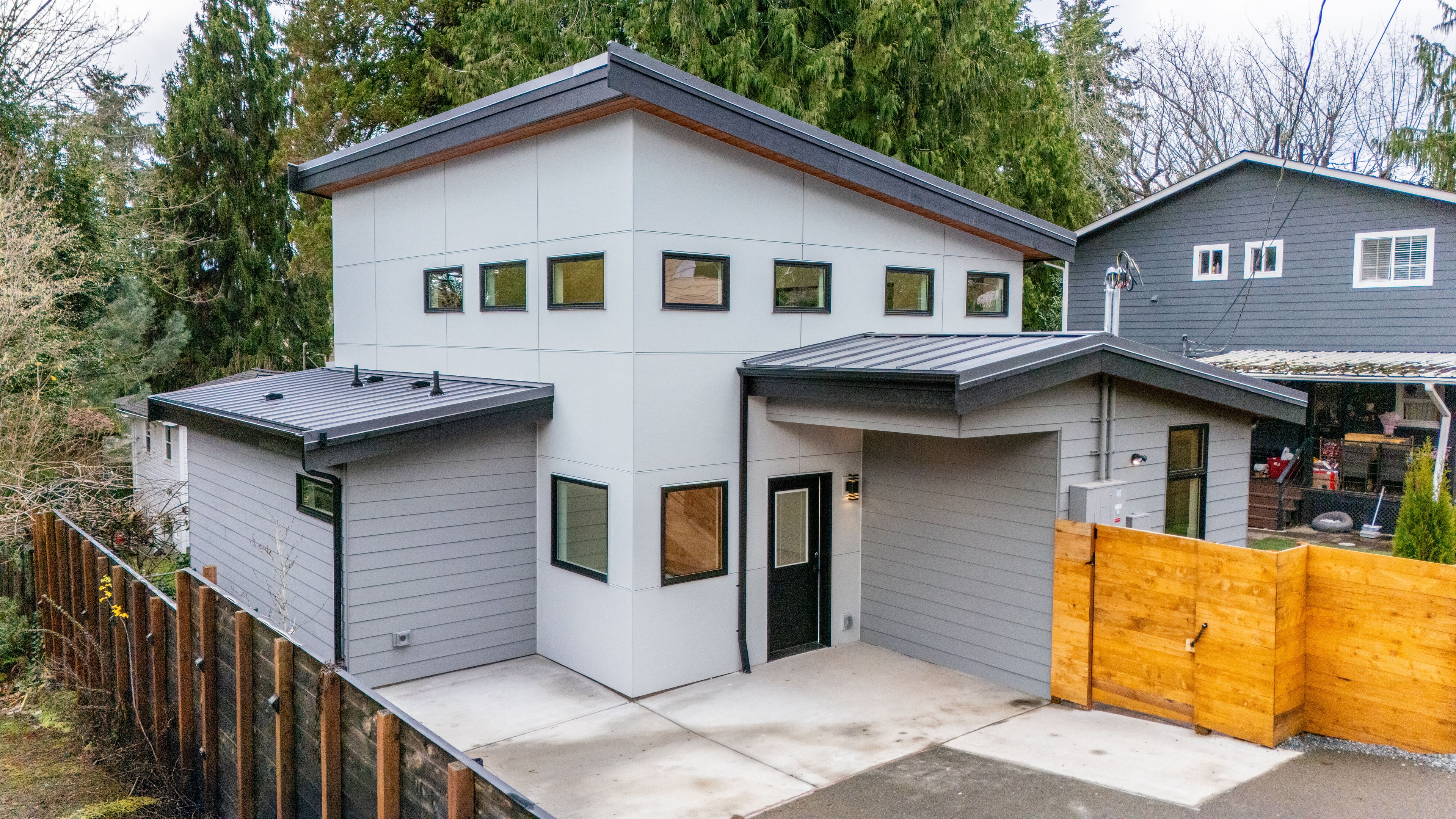
ADU & DADU Glossary
Every backyard-home term, in plain English.
Building an ADU comes with its own vocabulary — ECAs, setbacks, soft costs, side sewers. Here’s what each term actually means, so nothing in a quote or permit catches you off guard.
- 01
Accessory Dwelling Unit (ADU)
- A second, legally independent home on a lot zoned for a single house, with its own kitchen, bathroom, sleeping area and entrance. ADUs can be attached (AADU) or detached (DADU).
- 02
Attached ADU (AADU)
- An accessory dwelling unit built inside or onto the main house — for example a basement conversion, garage conversion, or addition with a separate entrance.
- 03
Backyard cottage
- A common name in Seattle for a DADU — a small, detached home built in the backyard of an existing house.
- 04
Detached ADU (DADU)
- A Detached Accessory Dwelling Unit — a standalone second home on the same lot as the main house, with its own foundation, utilities and roof.
- 05
Egress
- A code-required way to exit a room in an emergency, such as a properly sized window or door. Bedrooms and basement conversions must meet egress rules to be legal living space.
- 06
Environmental Critical Area (ECA)
- A protected or hazardous site condition — steep slope, landslide- or flood-prone ground, wetland or similar — that carries extra permitting requirements and can raise site-development costs.
- 07
Feasibility study
- An upfront assessment of whether and how a project can be built on a specific lot, reviewing zoning, setbacks, ECAs, utilities and soils, and producing a realistic starting budget before major spending begins.
- 08
Footprint
- The area of ground a building covers, measured at its outer walls. A DADU’s footprint is limited by lot-coverage and setback rules.
- 09
Growth Management Act (GMA)
- A Washington state law that guides how cities and counties plan for growth. Recent state ADU reforms apply to jurisdictions planning under the GMA.
- 10
Hard costs
- The direct cost of physically building — foundation, framing, systems and finishes. Typically 70–85% of a DADU budget.
- 11
Impact fees
- Fees local governments charge new construction to help pay for public infrastructure. Washington’s ADU law caps the impact fees that can be charged for an accessory dwelling unit.
- 12
In-fill
- New construction built on vacant or underused land within an already-developed neighborhood, rather than on the edge of a city. ADUs are a form of gentle in-fill housing.
- 13
Lot coverage
- The share of a lot that structures are allowed to cover, set by zoning. It’s one of the limits that determines how large a DADU can be.
- 14
Owner-occupancy requirement
- An old rule requiring the property owner to live on-site to have an ADU. Washington’s ADU reforms removed this requirement in many cases, making rentals more practical.
- 15
Setback
- The minimum required distance between a structure and the property lines. Setbacks shape where — and how big — a DADU can be placed on a lot.
- 16
Side sewer
- The private pipe that connects a building’s plumbing to the public sewer main. A new DADU usually needs its own side-sewer connection and permit.
- 17
Site development
- All the work that prepares a lot to build on — excavation, grading, drainage, utilities, retaining walls and foundations. On difficult lots this can be 15–30%+ of the total cost.
- 18
Soft costs
- The non-construction costs of a project — architecture, engineering, permits and geotechnical work. Typically about 10–15% of a DADU budget.
Want the bigger picture? Read the ADU & DADU FAQ, see how Washington's ADU laws changed, or estimate a build with the ADU cost calculator.
Still have questions?
Talk to a real builder.
Tell us about your lot and your goals. Eric follows up personally — the same person from the first call through final inspection. No pressure, no obligation.
- Owner-led — 35+ years, 100+ homes built
- Clear, line-item pricing · no hidden fees
- Serving Seattle, King & Snohomish County